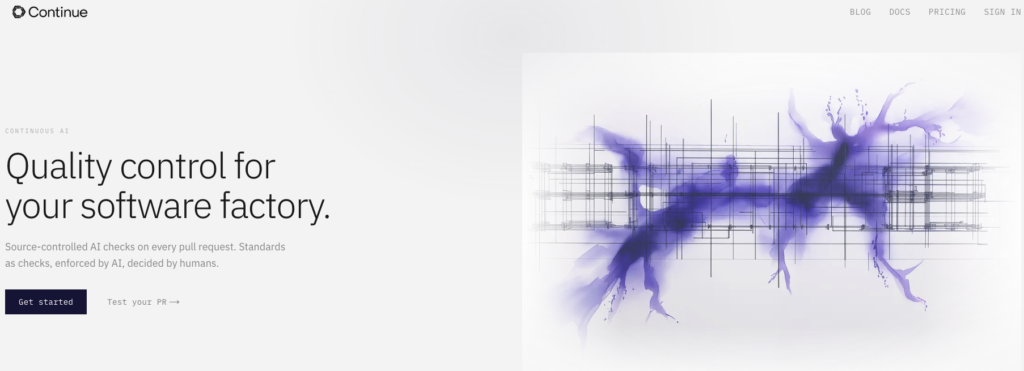
Continue is a focused developer tool built around a simple promise: turn the standards your engineering team already cares about into AI checks that run on every pull request. Instead of asking a general-purpose coding assistant to review everything, Continue positions itself as quality control for a modern software factory. The homepage describes it as “source-controlled AI checks on every pull request,” with standards enforced by AI and final decisions left to humans.
What is Continue?
Continue is not trying to be another broad chat interface for programmers. Its current product direction is narrower and more operational: teams write checks as markdown files in their repository, and Continue runs those checks as native GitHub status checks. If a pull request violates a convention, security pattern, architectural boundary, or team-specific rule, the check can flag the issue and suggest a fix. That makes Continue feel closer to CI, linting, and code review automation than to a traditional AI coding copilot.
The original site title, “Quality control for your software factory. | Continue,” captures the pitch well. Software teams are producing more code, and AI-assisted development has accelerated that flow. The bottleneck is no longer only writing code; it is keeping code aligned with the standards that make a system maintainable. Continue is aimed at that gap.
Key features
The most important feature is source control. Checks live in the repo, which means they can be reviewed, versioned, improved, and discussed like any other engineering artifact. That is a healthier model than burying review preferences in a vendor dashboard or relying on undocumented prompts. Teams can define what matters, keep those definitions visible, and change them as the codebase evolves.
Continue also integrates with GitHub pull requests as status checks. This matters because developers already understand the red-green workflow of CI. A failing check is not just a comment lost in a review thread; it becomes part of the merge signal. The site also emphasizes suggested fixes, which can reduce the friction of enforcement. A check that only says “this is wrong” creates work. A check that explains the problem and proposes a diff is much easier to adopt.
Another useful design choice is consistency over breadth. Generic AI reviewers often try to comment on everything: naming, architecture, bugs, style, performance, and sometimes issues that are not really issues. Continue’s pitch is the opposite. It should enforce what the team explicitly told it to catch and avoid unsolicited opinions. For mature teams, that restraint may be more valuable than broad coverage.
Who is Continue for?
Continue is best suited for engineering teams with recurring review standards that are hard to express with traditional static analysis. Examples include architectural boundaries, security review patterns, framework-specific conventions, migration rules, API design expectations, and “do not reinvent this internal tool” policies. If senior engineers keep writing the same review comments, those comments are candidates for a Continue check.
It is also a strong fit for teams that already take CI seriously. If your organization has a disciplined pull request process, clear ownership, and a habit of keeping tooling in the repository, Continue can slot into an existing workflow. Smaller teams can still benefit, but the return is highest when review consistency is becoming a real scaling problem.
Strengths
Continue’s biggest strength is that it treats AI review as an engineering system rather than a magic assistant. Source-controlled checks are auditable. GitHub status checks are visible. Markdown rules are approachable. The workflow gives humans control over standards while using AI for repetitive enforcement.
The product also addresses a real pain point in AI-era development. As code generation becomes cheaper, review load increases. Teams need a way to preserve judgment without making every senior engineer a full-time reviewer. Continue’s model can help by catching predictable issues before humans spend attention on them.
Finally, the focus is refreshing. Many AI developer tools chase a wide surface area. Continue’s website makes a sharper claim: run AI checks on every pull request, based on standards you define. That clarity makes the tool easier to evaluate.
Limitations
The same focus that makes Continue appealing also creates limitations. It is only as good as the checks a team writes. If your engineering standards are vague, outdated, or politically contested, turning them into AI checks will not solve the underlying problem. Teams need to invest time in designing good checks and maintaining them.
There is also a risk of false confidence. AI checks can catch patterns, but they should not replace human design review, security review, or ownership judgment. The homepage is careful to frame decisions as human-led, and that is the right posture. Continue should be treated as a review amplifier, not an autonomous gatekeeper.
Adoption may require cultural adjustment as well. Developers can tolerate strict linters because their behavior is predictable. AI checks need to earn trust by being consistent, explainable, and tuned to the team’s actual needs. Poorly written checks could become noise.
Final verdict
Continue is a promising tool for teams that want practical AI in the code review pipeline without surrendering control to a generic reviewer. Its best idea is simple: put your standards in source control and run them automatically on pull requests. That makes AI review more transparent, repeatable, and aligned with how engineering teams already work.
If your team is struggling with repeated review comments, inconsistent enforcement, or rising pull request volume, Continue is worth a serious look. It will not define your engineering culture for you, but it can help enforce the parts you have already chosen.
FAQ
Is Continue a replacement for human code review?
No. Continue is better understood as an automated layer that catches repeatable issues before or during review. Humans should still make architectural, product, and risk decisions.
How are Continue checks written?
Based on the website and related listings, checks are written as markdown files in the repository and run against pull requests as GitHub status checks.
What makes Continue different from a generic AI code reviewer?
Continue focuses on team-defined, source-controlled checks rather than broad unsolicited comments. The goal is consistent enforcement of known standards, not general commentary on every line of code.
Who should try Continue first?
Teams with repeated review rules, growing PR volume, and a GitHub-based workflow are the strongest candidates. It is especially relevant for engineering groups trying to keep quality high while AI-assisted coding increases output.