What Is Organic Maps?
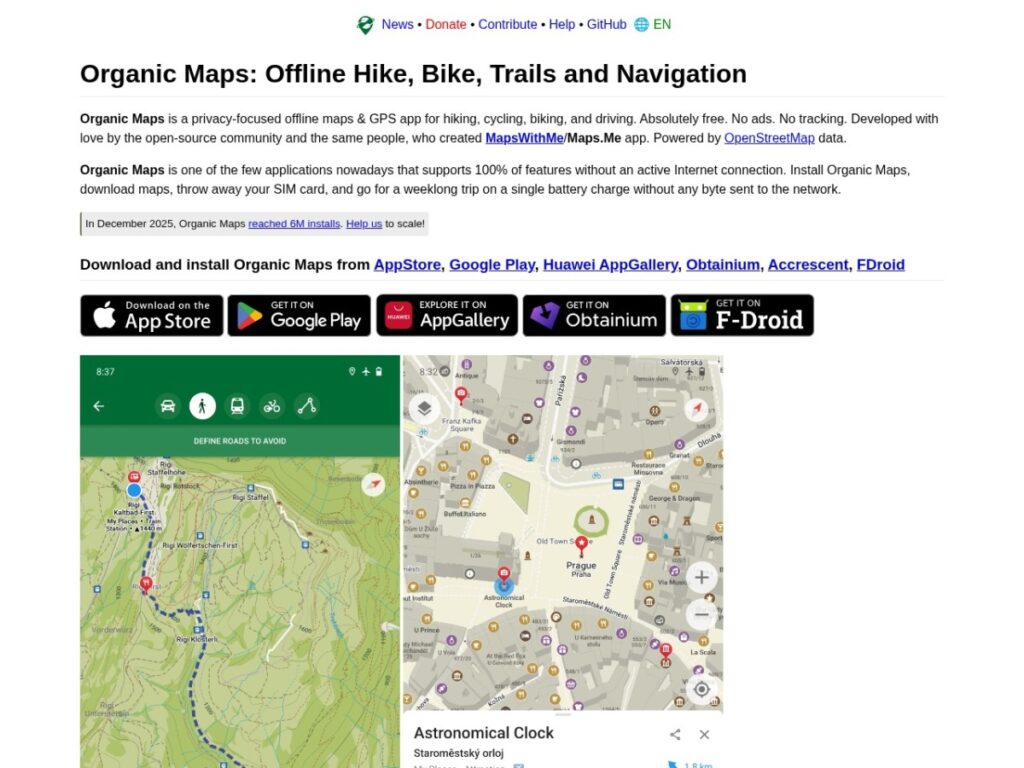
Organic Maps is a free offline maps and navigation app for Android and iOS. Based on the evidence available from its own website metadata, the app positions itself around four main ideas: offline access, privacy, speed, and open-source development. It is described as a detailed offline map app for travelers, tourists, drivers, hikers, and cyclists, with download options listed for the Apple App Store, Google Play, Huawei AppGallery, and F-Droid.
The site also states that Organic Maps was created by the founders of MapsWithMe / Maps.Me. That is a useful bit of context, because the product is not presented as a casual side project or a generic map clone. It is clearly aiming at people who already understand the value of having maps available without depending on live mobile data.
That said, this review is based only on the source evidence provided from the Organic Maps website. I cannot independently verify app performance, map coverage, routing accuracy, update frequency, privacy implementation, or user ratings from this evidence alone. The claims should be treated as product claims from the vendor, not as confirmed third-party test results.
What Problem Does It Solve?
Organic Maps addresses a simple but important problem: many navigation apps assume you have reliable internet access. That assumption breaks down quickly when traveling abroad, driving through poor-coverage areas, hiking in remote terrain, biking outside cities, or trying to avoid expensive roaming data.
An offline-first map app is useful when the map itself needs to be available before the trip begins. The evidence describes Organic Maps as offering detailed offline maps and navigation for several mobility types: travel, tourism, driving, hiking, and cycling. That combination suggests it is not only for road navigation, but also for people who care about trails and outdoor movement.
The privacy angle is another core problem the app claims to solve. Many mainstream map products are deeply tied to user accounts, advertising systems, location history, or broader data ecosystems. Organic Maps presents itself as privacy-focused and open-source. If accurate in practice, that makes it more attractive to people who want navigation without feeling that every route, search, or destination is being folded into a profile.
Key Features and Use Cases
The most important supported feature from the evidence is offline mapping. The site metadata repeatedly describes Organic Maps as an offline maps product, and the title specifically mentions “Offline Hike, Bike, Trails and Navigation.” For practical users, this is the central reason to consider it. You would likely use it before a trip, download the relevant map data, and keep it available when connectivity is poor or unavailable.
Another major feature is platform availability. Organic Maps is listed as a mobile application for Android and iOS. The evidence also includes download URLs for Apple’s App Store, Google Play, Huawei AppGallery, and F-Droid. F-Droid availability matters because it signals appeal to Android users who prefer open-source distribution channels and may avoid Google-dependent app flows.
The app also emphasizes multiple travel modes and audiences. The source text mentions travelers, tourists, drivers, hikers, and cyclists. That range is important. Some map apps are strong for city driving but weak for trails. Others are good for hiking but not built for everyday navigation. Organic Maps is trying to sit in the middle: a general-purpose offline map that also has enough trail and outdoor relevance to be useful beyond urban streets.
The open-source claim is also significant. The website includes a link to the Organic Maps GitHub presence in its structured organization data. Open-source status does not automatically mean an app is secure, private, or well-maintained, but it does create the possibility of public code review and community contribution. For privacy-conscious users, that is a meaningful advantage over a closed app where claims are harder to inspect.
Who Is Organic Maps For?
Organic Maps is best suited for people who value offline reliability more than account-driven convenience. Travelers who move between countries, tourists who do not want to burn mobile data, hikers who may lose signal, cyclists planning routes away from dense urban coverage, and drivers passing through low-connectivity areas are the most obvious users.
It is also a natural fit for privacy-conscious users. The available evidence repeatedly uses the phrase privacy-focused, and the open-source positioning reinforces that identity. If you are uncomfortable with large mapping platforms collecting location-related behavior, Organic Maps is the kind of alternative you would evaluate.
Android users who prefer F-Droid may find it especially appealing, since the app is listed there as well as on mainstream stores. iPhone users are also covered through the App Store listing. The app is not presented as a web tool or desktop planner in the evidence; it is specifically structured as a mobile application.