Upvote RSS Review: What It Appears to Offer
Upvote RSS is a small, focused web tool for generating RSS feeds from social aggregation websites. Based on its public homepage, the tool is designed for people who want to follow high-signal posts from communities such as Hacker News, GitHub, Lemmy, Lobsters, Mbin, PieFed, and, in self-hosted mode, Reddit.
This review is based only on the public homepage information available for Upvote RSS, not on authenticated hands-on testing or long-term use. That matters because RSS tools can behave differently depending on caching, rate limits, source-site changes, and reader compatibility. Still, the homepage provides enough detail to understand the product’s intent and who it is likely for.
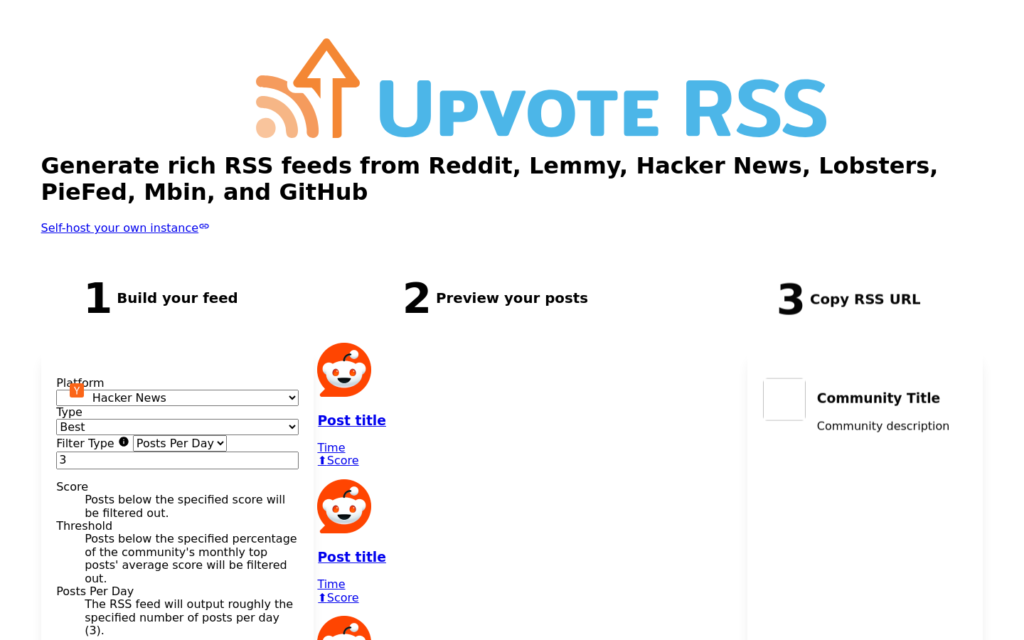
At a high level, Upvote RSS helps users build a feed by choosing a platform, selecting a community or category, applying filters, previewing posts, and copying an RSS URL. The example URL shown on the homepage is configured for Hacker News best stories with roughly three posts per day and article content included.
The Core Idea: Better RSS from Vote-Based Communities
Traditional RSS works well when a publication offers a clean feed. It is less straightforward when the source is a social site where posts are ranked by score, popularity, freshness, community, or category. Upvote RSS appears to solve that problem by turning ranked social content into feed-reader-friendly output.
The homepage describes the product as a way to “Generate rich RSS feeds from Reddit, Lemmy, Hacker News, Lobsters, PieFed, Mbin, and GitHub.” That positioning is specific: it is not trying to be a general automation platform, newsletter tool, or social media dashboard. It is aimed at people who still prefer RSS but want more control over what enters their reader.
For example, instead of manually checking Hacker News best stories or a Lemmy community, a user could generate a feed that only sends a manageable number of posts per day. That is useful for reducing noise, especially on fast-moving or high-volume sites.
Building a Feed
The homepage includes a “Build your feed” section with several visible configuration options. Users can choose a platform from GitHub, Hacker News, Lemmy, Lobsters, Mbin, PieFed, and Reddit, although Reddit is marked as “available only self-hosted.”
Depending on the platform, the interface appears to expose different fields such as subreddit, front page, best, new, ask, show, category, tag, language, topic, instance, community, and magazine. The visible text suggests Upvote RSS adapts its controls to the chosen platform rather than presenting one generic form for everything.
Filtering is also a major part of the product. The homepage references score thresholds, score percentage filtering, and posts per day. One explanation says posts below a specified score will be filtered out. Another says posts below a specified percentage of the community’s monthly top posts’ average score will be filtered out. The posts-per-day setting indicates that the feed will output roughly the specified number of posts per day.
That “roughly” is worth noticing. It suggests the tool is shaping feed volume rather than guaranteeing an exact publishing schedule. For RSS readers, that is usually fine; the goal is to make a feed useful, not to hit a strict quota.
Rich Feed Options and Fiddly Bits
Upvote RSS also includes a section labeled “Fiddly bits,” which is refreshingly honest terminology for advanced options that power users may care about.
Visible options include showing score in the feed, including article content, including summaries, including comments, filtering pinned comments, filtering old posts, setting days to keep, filtering NSFW posts, and blurring NSFW Reddit media. There is also a custom Reddit domain option and a Reddit domain field.
Because this review is based only on homepage evidence, it would be unfair to claim exactly how each option behaves in every feed reader. But the presence of these controls suggests Upvote RSS is not just producing bare links. It is intended to generate richer feeds that can include context beyond a simple title and URL.
The “Include article content” option is especially relevant for people who want to read from within an RSS client rather than clicking through every item. However, readers should evaluate how well this works with their preferred sources. Article extraction can vary significantly depending on the target website, formatting, paywalls, scripts, and source changes.
Previewing Posts Before Copying the RSS URL
The homepage includes a “Preview your posts” area with placeholder post titles, time, and score. It also shows a “Copy RSS URL” section and an RSS feed URL field. The visible generated URL includes parameters for platform, community, average posts per day, content, and RSS view.
This is a practical workflow: configure the feed, preview the expected posts, then copy the RSS URL into a reader. For an RSS utility, that is exactly the right amount of ceremony. Users should not need an elaborate onboarding sequence just to create a feed.
The homepage also shows a “Refresh cache” option and a cache size indicator of 54 MB. That suggests the tool uses caching, which is common and sensible for public feeds. Caching can reduce load and improve response times, though it may also mean updates are not instant. Anyone relying on Upvote RSS for time-sensitive monitoring should test refresh behavior before making it part of a critical workflow.
Likely Use Cases
Keeping Up With Hacker News Without Doomscrolling
The provided URL is already configured for Hacker News best stories with about three posts per day. That is a strong example of the product’s value: instead of visiting Hacker News repeatedly, users can receive only a small number of high-ranking posts in their RSS reader.
This could work well for developers, founders, researchers, and writers who want awareness of tech discussions without turning the site into a constant distraction.
Following Decentralized Communities
Support for Lemmy, PieFed, Mbin, and Lobsters makes Upvote RSS interesting for people who follow federated or community-driven spaces. These communities can be scattered across instances, topics, tags, and categories. A configurable RSS builder can make them easier to monitor from one place.